
International Space Station facts for kids

Obverse view in November 2021
|
|

International Space Station program emblem with flags of the original signatory states
|
|
| Station statistics | |
|---|---|
| Call sign | Alpha, Station |
| Crew |
|
| Launch | 20 November 1998 |
| Launch pad |
|
| Mass | 450,000 kg (990,000 lb) |
| Length | 358 ft (109 m) (overall), 310 ft (94 m) (truss) |
| Width | 239 ft (73 m) (solar array) |
| Pressurised volume | 35,491 cu ft (1,005.0 m3) |
| Atmospheric pressure | 1 atm (101.3 kPa; 14.7 psi) 79% nitrogen, 21% oxygen |
| Perigee | 413 km (256.6 mi) AMSL |
| Apogee | 422 km (262.2 mi) AMSL |
| Orbital inclination | 51.64° |
| Orbital speed | 7.67 km/s; 27,600 km/h; 17,100 mph |
| Orbital period | 92.9 minutes |
| Orbits per day | 15.5 |
| Orbit epoch | 16 August 16:19:30 |
| Days in orbit | 27 years, 5 months, 24 days as of 14 May 2026 |
| Days occupied | 25 years, 6 months, 11 days as of 14 May 2026 |
| No. of orbits | 154,278 as of 30 April 2026[update] |
| Orbital decay | 2 km/month (1.2 mi/month) |
| Statistics as of 30 April 2026 (unless noted otherwise) |
|
| Configuration | |

Station elements as of 2026[update]
(exploded view with the names of elements coloured by country) |
|
The International Space Station (ISS) is a huge space station that orbits Earth very closely. It is a project of five different space agencies working together: NASA from the United States, Roscosmos from Russia, the ESA, JAXA from Japan, and the CSA. The ISS is special because it was built and is run by many countries working as a team. It is also the biggest spacecraft ever built for humans.
The station flies about 400 kilometres (250 miles) above Earth, circling the planet every 93 minutes. This means it goes around Earth about 15.5 times each day! It travels at an amazing speed of 7.67 km/s (27,600 km/h; 17,200 mph). The ISS is as big as a football field, measuring 358 ft (109 m) long and 239 ft (73 m) wide. Inside, it has as much room as a Boeing 747 airplane.
The ISS is like a science lab in space. Scientists use it to do experiments in microgravity (which feels like weightlessness) and to study the space environment. Humans have lived on the ISS continuously since November 2, 2000, making it the longest time people have stayed in space without a break. Today, the ISS and China's Tiangong are the only two space stations where people live and work.
The ISS is made of many parts, called modules, that connect together. It has two main sections: the Russian Orbital Segment (ROS) and the US Orbital Segment (USOS). A large structure called the Integrated Truss Structure holds the station's huge solar panels and cooling systems. These modules are used for science, living spaces for astronauts, storage, and controlling the spacecraft. The ISS has eight places where other spacecraft can connect. In total, the station has 43 different parts.
The idea for the ISS came from combining two earlier space station plans: the United States' Space Station Freedom and the Soviet Union's Mir-2. The first part of the ISS was launched in 1998. Big parts were sent into space by Proton and Soyuz rockets, and the Space Shuttle. The first crew, Expedition 1, arrived on November 2, 2000. Since then, 294 people from 26 countries have visited the station.
The ISS is expected to keep working until the end of 2030. After that, some of its parts might be used for new stations like the Axiom Station and the Russian Orbital Service Station. The plan is to guide the ISS to safely fall out of orbit using a special vehicle.
Contents
- Why We Have the International Space Station
- Working Together in Space
- Building the Space Station
- How the Space Station is Built
- Pressurized Modules: Living and Working Spaces
- Zarya: The First Piece
- Unity: The Central Hub
- Zvezda: The Russian Core
- Destiny: The US Science Lab
- Quest Joint Airlock: Spacewalk Exit
- Poisk: Russian Docking and Airlock
- Harmony: Connecting the Labs
- Tranquility: Life Support and Views
- Columbus: Europe's Lab
- Kibō: Japan's Experiment Module
- Cupola: The Window to Earth
- Rassvet: Russian Storage and Docking
- Leonardo: The Permanent Storage Module
- Bigelow Expandable Activity Module (BEAM)
- International Docking Adapters (IDA)
- Bishop Airlock Module
- Nauka: Russia's New Lab
- Prichal: Russian Docking Hub
- Unpressurized Elements: Outside the Station
- Former Module: Pirs
- Planned Components: The Future of the ISS
- Cancelled Components: Ideas That Didn't Fly
- Pressurized Modules: Living and Working Spaces
- How the Space Station Works
- Life on the Space Station
- The End of the Mission
- Cost of the Space Station
- The ISS in Culture
- Images for kids
- See also
Why We Have the International Space Station
The ISS was first planned to be a place for science experiments, observing space, and making things. It was also meant to be a stop for future trips to the Moon, Mars, and asteroids. Over time, it also became important for business, diplomacy (countries working together), and teaching.
Doing Science in Space
The ISS is a unique place for science because it has power, computers, cooling, and astronauts to help with experiments. While small uncrewed spacecraft can also do experiments in space, the ISS offers a long-term home where studies can happen for many years. Human researchers can easily access the experiments.


Scientists on Earth can get data quickly and suggest changes to experiments. New equipment can be sent up easily on resupply missions. Astronauts live on the station for several months, working on many projects.
A very important experiment on the ISS is the Alpha Magnetic Spectrometer (AMS). It looks for dark matter and tries to answer big questions about the universe. NASA says the AMS is as important as the Hubble Space Telescope. It needs a lot of power and data, so it works best on the station.
Space is a very harsh place for living things. Outside Earth's protection, there is strong radiation, a vacuum, extreme temperatures, and microgravity. Some tough life forms, like extremophiles and tiny tardigrades, can survive in this environment by drying out completely.
Medical research on the ISS helps us understand how long stays in space affect the human body. This includes muscle atrophy (muscles getting weaker), bone loss, and changes in body fluids. This information is key to knowing if humans can travel to distant planets like Mars for long periods.
One medical study, Advanced Diagnostic Ultrasound in Microgravity, teaches astronauts to do ultrasound scans with help from experts on Earth. This helps diagnose and treat medical problems in space, where there isn't usually a doctor. This skill could also help people in remote areas on Earth.
In 2020, scientists found that certain bacteria from Earth, like Deinococcus radiodurans, could survive in space for three years on the ISS. This supports the idea of panspermia, which suggests that life might spread throughout the universe in things like meteoroids or comets.
Astronauts on the ISS also study Earth, stars, and deep space. They look at things like aerosols, ozone, and lightning in Earth's atmosphere. They also study the Sun, cosmic rays, and dark matter in the universe.
Exploring Microgravity's Effects


Researchers study how the near-weightless environment affects plants and animals. They look at how things grow and change. NASA is also studying how microgravity affects the growth of human-like tissues and special protein crystals that form in space.
Studying how liquids behave in microgravity helps us understand them better. Liquids that don't mix well on Earth can combine almost completely in space. This helps physicists learn new things. Scientists also study reactions that slow down in low gravity and cold temperatures, which can help us understand superconductivity.
Studying materials science on the ISS is important for finding new ways to make things better on Earth. Scientists also look at how fire burns in low gravity. This research could help us produce energy more efficiently and reduce pollution.
Preparing for Future Space Travel
The ISS is a safe place in low Earth orbit to test systems needed for long trips to the Moon and Mars. Astronauts learn how to operate, maintain, and repair spacecraft in orbit. This helps them develop important skills for missions far from Earth and makes future space travel safer.
Many countries work together on the ISS. This teamwork is very important for big missions, like sending humans to Mars.
Learning and Sharing from Space

The ISS crew helps students on Earth by running experiments designed by kids, doing educational demonstrations, and talking to students through radio and email. The ESA offers free teaching materials for classrooms.
The Japanese Aerospace Exploration Agency (JAXA) wants to inspire children to learn about science and space. In their "Seeds in Space" experiments, students grow sunflower seeds that have been in space to see how spaceflight affects them.
Cultural activities are also a big part of the ISS program. As one JAXA director said, "There is something about space that touches even people who are not interested in science."
The Amateur Radio on the ISS (ARISS) program connects students with astronauts using amateur radio. This encourages kids to study science, technology, engineering, and math.
In 2011, a documentary called First Orbit was made using footage filmed from the ISS. Astronaut Paolo Nespoli filmed what Yuri Gagarin saw on his first space flight. In 2013, commander Chris Hadfield filmed the first music video in space, singing David Bowie's "Space Oddity". In 2017, Paolo Nespoli recorded his voice for Wikipedia articles while on the station.
Working Together in Space

The International Space Station is a huge project involving five space programs and fifteen countries. It is one of the most complex space programs ever. The 1998 Space Station Intergovernmental Agreement set up how these countries would work together. Other agreements cover things like rules for astronauts.
Brazil was invited to join but could not provide the necessary parts due to funding issues. They officially left the program in 2007.
There have been discussions about Russia's future involvement in the ISS program. In 2022, Russia announced plans to withdraw from the program after 2024. NASA has made plans for other companies, like Northrop Grumman, to help keep the ISS in orbit if needed.
Countries Working on the ISS


Building the Space Station
How the Parts Were Made

The parts of the ISS were built all over the world. Russian modules like Zarya and Zvezda were made in Moscow. Zvezda was originally built in 1985 for another space station that was never launched.
Many parts of the US Orbital Segment, like the Destiny and Unity modules, the Integrated Truss Structure, and solar arrays, were built in the United States.
The European Columbus module was built in Germany, and Japan's Kibō module was built in Japan. Canada contributed the Canadarm2 and Dextre robotic arms. All these parts were sent to Florida for final checks before launch.
Putting It All Together

Building the International Space Station started in November 1998. Russian modules launched by themselves and connected automatically. Other modules were brought by the Space Shuttle and installed by astronauts during spacewalks or using robotic arms. By June 2011, astronauts had done over 159 spacewalks to add parts to the station.
The first part, the Russian-built Zarya module, launched on November 20, 1998. It provided power, control, and communications. Two weeks later, the American Unity module was brought by Endeavour and connected to Zarya. Unity became the link between the Russian and US parts of the station.
At first, these two modules didn't have life-support systems, so no one lived on them. The turning point came in July 2000 with the launch of the Zvezda module. It had living quarters and life-support systems, allowing humans to live on the station continuously. The first crew, Expedition 1, arrived in November 2000.

The ISS grew steadily. The Pirs docking compartment, the American Destiny laboratory, and the Quest airlock were added. The station also got its main robot arm, the Canadarm2, and more parts of the Integrated Truss Structure.
In 2003, the loss of the Space Shuttle Columbia stopped construction for a while. Assembly started again in 2006, adding more solar arrays and truss segments. This allowed more modules to be added, like the US Harmony module, the European Columbus laboratory, and the Japanese Kibō laboratory.
The US Tranquility module and the Cupola observation deck were added in 2010. The Russian Rassvet module and the US Leonardo module were also added around this time.
More recently, Russia's new research module Nauka docked in July 2021, bringing the European Robotic Arm. Russia's latest addition, the Prichal module, docked in November 2021. As of May 2026, the ISS has 43 different modules and elements.
How the Space Station is Built
The ISS is a modular space station, meaning parts can be added or removed.
-
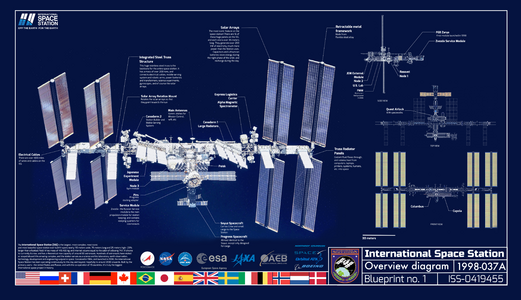
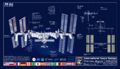
Blueprint of the ISS (as of 2018)
-
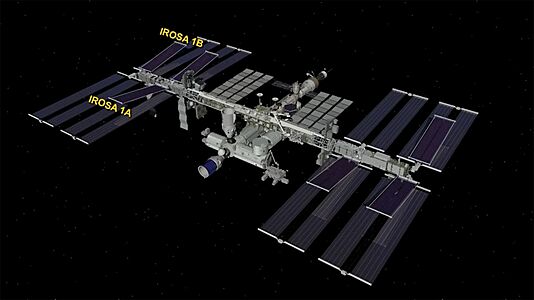
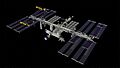
Rendering of the ISS (as of 2023)


Below is a diagram of the main parts of the station.
| Russian docking port |
|||||||||||||||||||||||||||||||||||||||||||||||||||||||
| Means of attachment of large payloads |
Heat radiator | Poisk | Russian docking port |
||||||||||||||||||||||||||||||||||||||||||||||||||||
| Portable workpost | |||||||||||||||||||||||||||||||||||||||||||||||||||||||
| European Robotic Arm | Solar array | Zvezda | Solar array | ||||||||||||||||||||||||||||||||||||||||||||||||||||
| Solar array | Nauka | Solar array | Pirs | Russian docking port |
|||||||||||||||||||||||||||||||||||||||||||||||||||
| Russian docking port |
Experiment airlock | ||||||||||||||||||||||||||||||||||||||||||||||||||||||
| Russian docking port |
Prichal | Russian docking port |
|||||||||||||||||||||||||||||||||||||||||||||||||||||
| Russian docking port |
Russian docking port |
||||||||||||||||||||||||||||||||||||||||||||||||||||||
| Solar array | Zarya | Solar array | |||||||||||||||||||||||||||||||||||||||||||||||||||||
| Russian docking port |
Rassvet | ||||||||||||||||||||||||||||||||||||||||||||||||||||||
| iROSA | iROSA | iROSA | iROSA | ||||||||||||||||||||||||||||||||||||||||||||||||||||
| Solar array | Solar array | Heat radiator | Heat radiator | Solar array | Solar array | ||||||||||||||||||||||||||||||||||||||||||||||||||
| ELC 2, AMS | Z1 truss | ELC 3 | |||||||||||||||||||||||||||||||||||||||||||||||||||||
| S5/6 Truss | S3/S4 Truss | S1 Truss | S0 Truss | P1 Truss | P3/P4 Truss | P5/6 Truss | |||||||||||||||||||||||||||||||||||||||||||||||||
| ELC 4, ESP 3 | ELC 1 | ||||||||||||||||||||||||||||||||||||||||||||||||||||||
| Dextre robotic arm |
Canadarm2 robotic arm |
||||||||||||||||||||||||||||||||||||||||||||||||||||||
| Solar array | Solar array | Solar array | Solar array | ||||||||||||||||||||||||||||||||||||||||||||||||||||
| iROSA | iROSA | iROSA | iROSA | ||||||||||||||||||||||||||||||||||||||||||||||||||||
| PMA 1 | BEAM | ||||||||||||||||||||||||||||||||||||||||||||||||||||||
| ESP-2 | Quest airlock | Unity | Tranquility | Bishop airlock | |||||||||||||||||||||||||||||||||||||||||||||||||||
| Cupola | |||||||||||||||||||||||||||||||||||||||||||||||||||||||
| Cargo spacecraft berthing port |
|||||||||||||||||||||||||||||||||||||||||||||||||||||||
| Leonardo | |||||||||||||||||||||||||||||||||||||||||||||||||||||||
| ESP-1 | Destiny | ||||||||||||||||||||||||||||||||||||||||||||||||||||||
| PMA / IDA docking port |
|||||||||||||||||||||||||||||||||||||||||||||||||||||||
| Kibō cargo bay |
Kibō robotic arm |
||||||||||||||||||||||||||||||||||||||||||||||||||||||
| External payloads | Columbus | Harmony | Kibō | Kibō external platform |
|||||||||||||||||||||||||||||||||||||||||||||||||||
| Cargo spacecraft berthing port |
|||||||||||||||||||||||||||||||||||||||||||||||||||||||
| PMA / IDA docking port |
|||||||||||||||||||||||||||||||||||||||||||||||||||||||
Pressurized Modules: Living and Working Spaces
These are the parts of the station where astronauts live and work without needing a spacesuit.
Zarya: The First Piece

Zarya (meaning "Sunrise" in Russian) was the very first part of the ISS, launched in 1998. It first provided power, storage, and guidance for the station. As the ISS grew, Zarya's main job became storage. It was built in Russia but is owned by the United States. Its name shows the start of a new era of space cooperation.
Unity: The Central Hub

Unity, also called Node 1, was the first US-built part of the ISS. It connects the Russian and US sections. This cylinder-shaped module has six places to attach other modules. Unity was built by Boeing in Alabama. It is one of three connecting nodes that form the main structure of the US part of the ISS.
Zvezda: The Russian Core
.jpg)
Zvezda (meaning "Star" in Russian) launched in July 2000. It is the main part of the Russian Orbital Segment. It first provided living quarters and life-support systems, allowing humans to live on the station all the time. Zvezda is still the command center for the Russian section and where crews go during emergencies.
Destiny: The US Science Lab

The Destiny laboratory is the main place for US experiments on the ISS. It was built by Boeing and launched in February 2001. Since then, it has been a busy place for scientific research. Astronauts do experiments in medicine, engineering, physics, and Earth science here. The module also has systems to keep the air breathable, like the Oxygen Generating System.
Quest Joint Airlock: Spacewalk Exit

The Quest Joint Airlock is where astronauts go in and out for spacewalks. It allows them to use either the US Extravehicular Mobility Unit (EMU) spacesuits or the Russian Orlan space suits. Before Quest, spacewalks were harder because of different suit designs. Launched in July 2001, Quest has two sections: one for astronauts to exit and one for storing suits. It also helps astronauts prepare for spacewalks.
Poisk: Russian Docking and Airlock

Poisk (meaning "Search" in Russian) is a secondary airlock on the Russian part of the ISS. It also allows Soyuz spacecraft and Progress cargo spacecraft to dock. Poisk launched in November 2009. It has facilities to store and maintain Orlan spacesuits. Since the Pirs module left in 2021, Poisk is the only airlock on the Russian segment.
Harmony: Connecting the Labs

Harmony, or Node 2, is the main connection point for the US segment. It links the US, European, and Japanese science labs. It's called the "utility hub" because it provides power, data, and life-support systems. Harmony also has sleeping areas for four crew members. It launched in October 2007.
Tranquility: Life Support and Views

Tranquility, or Node 3, is another module on the ISS. It holds systems that control the environment, life-support systems, a toilet, exercise equipment, and a special observation cupola with large windows. The European Space Agency and the Italian Space Agency had Tranquility built in Italy. NASA launched it in February 2010.
Columbus: Europe's Lab

Columbus is a science laboratory and Europe's biggest contribution to the ISS. It was built in Italy and Germany. It launched in February 2008 and is designed to work for ten years. The module is controlled from Germany. Europe spent about €1.4 billion (about US$1.6 billion) to build Columbus and its experiments.
Kibō: Japan's Experiment Module

Kibō (meaning "Hope" in Japanese) is Japan's research facility on the ISS. It is the largest single module on the station. It has a pressurized lab, an outdoor area for experiments in space, two storage rooms, and a robotic arm. Kibō was put together in space during three Space Shuttle missions.
Cupola: The Window to Earth

The Cupola is an observation module built by the ESA. Its name comes from the Italian word for "dome." Its seven windows are used for experiments, watching spacecraft dock, and observing Earth. It launched in February 2010 and is attached to the Tranquility module. The Cupola's central window is 80 cm (31 in) wide.
Rassvet: Russian Storage and Docking

Rassvet (meaning "First Light" in Russian) is mainly used for storing cargo and as a docking port for visiting spacecraft on the Russian segment. It launched in May 2010. Rassvet was attached to Zarya shortly after its arrival.
Leonardo: The Permanent Storage Module

The Leonardo Permanent Multipurpose Module (PMM) arrived in space in February 2011. It is mainly used for storing spare parts, supplies, and waste on the ISS. It also serves as a personal hygiene area for astronauts in the US Orbital Segment. Leonardo was named after the famous Italian inventor Leonardo da Vinci.
Bigelow Expandable Activity Module (BEAM)

The Bigelow Expandable Activity Module (BEAM) is an experimental module that can expand in space. It was developed by Bigelow Aerospace for NASA to test on the ISS. It arrived in April 2016 and was expanded in May 2016. In 2021, Bigelow Aerospace gave ownership of the module to NASA.
International Docking Adapters (IDA)
The International Docking Adapter (IDA) is a special connector that allows newer spacecraft to dock with the ISS. Two IDAs are currently on the station, attached to the Harmony module. IDA-2 was installed in August 2016, and IDA-3 was installed in August 2019.
Bishop Airlock Module

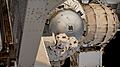
The NanoRacks Bishop Airlock Module is a commercially funded airlock. It launched to the ISS in December 2020. This module is used to send small satellites, called CubeSats, and other equipment outside the station for various customers.
Nauka: Russia's New Lab
.jpg)
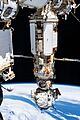
Nauka (meaning "Science" in Russian) is a new Russian module that launched in July 2021. It docked to the Zvezda module in July 2021, replacing the Pirs module. It has a temporary docking port for spacecraft.
Prichal: Russian Docking Hub
Prichal (meaning "Pier" in Russian) is a spherical module that acts as a docking hub for the Russian part of the ISS. It launched in November 2021. Prichal has six docking ports for Soyuz and Progress spacecraft, and possibly future modules.
Unpressurized Elements: Outside the Station


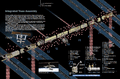
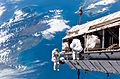
The ISS has many parts outside that don't need to be pressurized. The biggest of these is the Integrated Truss Structure (ITS). This structure holds the station's main solar arrays (which generate power) and thermal radiators (which cool the station). The ITS is 108.5 metres (356 ft) long.
The station also has smaller external parts like robotic arms, External Stowage Platforms (ESPs), and ExPRESS Logistics Carriers (ELCs). These platforms allow experiments to be done in the vacuum of space. They also store spare parts called ORUs, which are replaced when they break or wear out.
The Alpha Magnetic Spectrometer (AMS), a particle physics experiment, is the largest scientific payload mounted outside the ISS. It looks for evidence of dark matter and antimatter.
MLM Outfittings

.jpg)
In May 2010, equipment for the Nauka module was launched and attached to the outside of Rassvet. This included a spare elbow joint for the European Robotic Arm (ERA), a workpost for spacewalks, and a heat radiator. The radiator helps cool Nauka so it can do more science experiments. The ERA was used to move the radiator to Nauka. However, this radiator later had a leak, which means Nauka's experiments might not be able to use its full cooling power.
Robotic Arms and Cranes


The Integrated Truss Structure is home to the station's main robotic system, the Mobile Servicing System (MSS). It has three main parts:
- Canadarm2: The largest robotic arm, used to move spacecraft and modules, hold astronauts during spacewalks, and move Dextre.
- Dextre: A robotic manipulator with two arms that can do delicate tasks like replacing parts.
- Mobile Base System (MBS): A platform that moves along rails on the truss, allowing Canadarm2 and Dextre to reach different parts of the US segment.
Japan has its own Japanese Remote Manipulator System to work with the Kibō module. The European Robotic Arm works on the Russian segment. Russian cosmonauts also use two Strela (meaning "Arrow") cranes during spacewalks to move themselves and equipment.
Former Module: Pirs


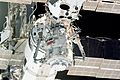
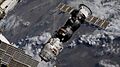
Pirs (meaning "Pier" in Russian) was launched in September 2001. It was the main Russian airlock on the station and was used to store and fix Russian Orlan spacesuits. Pirs was undocked in July 2021 and safely burned up in Earth's atmosphere to make room for the Nauka module.
Planned Components: The Future of the ISS
Axiom Segment: A Commercial Future

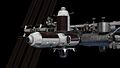
In 2020, NASA hired Axiom Space to build a commercial module for the ISS. Axiom plans to launch one module, the Payload Power Thermal Module (PPTM), to the ISS no earlier than 2027. This module will temporarily dock with the ISS. Later, Axiom plans to detach its modules and form a new, independent space station called Axiom Station, which could be a successor to the ISS. The Canadarm2 is planned to move to Axiom Station after the ISS retires.
US Deorbit Vehicle: A Safe End
The US Deorbit Vehicle (USDV) is a spacecraft that NASA plans to use to safely guide the ISS out of orbit at the end of its life in 2030. In June 2024, NASA chose SpaceX to build this vehicle. It will be a modified Cargo Dragon spacecraft with extra thrusters and fuel.
Cancelled Components: Ideas That Didn't Fly
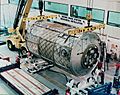
Several modules planned for the station were cancelled. This happened because of budget limits, or because the modules were no longer needed, or due to changes after the 2003 Columbia accident. For example, a US Habitation Module was planned for living quarters, but now living spaces are spread throughout the station.
How the Space Station Works
Life Support: Keeping Astronauts Alive

The ISS has important systems to keep the air, water, and food safe for astronauts. It also has equipment for hygiene and fire safety. The Russian Zvezda module has many of these life-support systems, and the US segment has some too.
Breathing Easy: Atmospheric Control
The air inside the ISS is very similar to the air on Earth. The normal air pressure is the same as at sea level. The Elektron system in Zvezda and a similar system in Destiny make oxygen. Astronauts also have backup oxygen tanks and special "candles" that produce oxygen. Carbon dioxide is removed from the air by the Vozdukh system in Zvezda.
Power and Heat: Keeping Things Running


Large, double-sided solar arrays provide electricity to the ISS. These panels collect sunlight on both sides, making them very efficient. The Russian segment uses 28 volts of direct current (DC) power. The US segment uses 130–180 volts DC. The station's solar arrays usually follow the Sun to make the most power.
The station uses lithium-ion batteries to store power. These batteries provide electricity when the station is in Earth's shadow (about 45 minutes of every 90-minute orbit).
The station's systems and experiments create a lot of heat. To keep the inside temperature comfortable, the ISS has a cooling system. This system uses water inside the station and liquid ammonia in external radiators. The radiators release the heat into space.
Talking and Computing: Communications and Computers
The ISS uses different radio systems to send information and data between the station and control centers on Earth. Radios are also used for docking spacecraft and for astronauts to talk to each other and their families.
The Russian segment uses the Lira antenna for direct communication with Earth. It can also use the Luch data relay satellites. The US segment uses S band and Ku band systems, which send signals through the US Tracking and Data Relay Satellite System (TDRSS).
UHF radio is used by astronauts during spacewalks and by spacecraft docking with the station.


The US segment of the ISS has about 100 laptops. These laptops are changed to work with the station's power system and have extra cooling. Some laptops run Linux and control the station's main systems. Other laptops are used for daily tasks like checking procedures, managing experiments, sending emails, video chats, and entertainment. Astronauts on the ISS have access to the internet.
Life on the Space Station
Living Quarters: Home Away From Home

The ISS is bigger than a six-bedroom house! It has seven private sleeping areas, three bathrooms, two dining rooms, a gym, and a special bay window with a 360-degree view.
Astronauts have their own small, soundproof sleeping booths. These have a sleeping bag, a reading lamp, and storage for personal items. Visiting astronauts might sleep in tethered sleeping bags attached to a wall. Good air circulation is important so that carbon dioxide doesn't build up around their heads.
The station's lights can be adjusted to help astronauts work and sleep.
Daily Life: Crew Activities

The ISS follows Coordinated Universal Time (UTC). A typical day starts at 6:00 AM with wake-up and a check of the station. After breakfast, the crew talks with Mission Control and starts work around 8:10 AM. Mornings include exercise, science experiments, and maintenance. After a one-hour lunch, they continue working and exercising. Bedtime is usually at 9:30 PM.
Astronauts work about 10 hours on weekdays and 5 hours on Saturdays. Their free time is for hobbies, talking to family, or looking at Earth from the windows. They can also watch TV. Since the ISS sees 16 sunrises and sunsets each day, the windows are covered during sleep times to make it feel like night.
Food: Meals in Microgravity

Food on the ISS is specially packaged to last a long time and prevent crumbs from floating around. Because taste can be dulled in microgravity, meals often have stronger flavors. Astronauts love when resupply missions bring fresh fruits and vegetables.
Liquids are in bags with straws, and solid foods are eaten with utensils attached to trays by magnets. Any floating food must be collected so it doesn't clog air filters.
The Zvezda module has a kitchen with a food warmer and water dispenser. Many Russian meals come in cans. The Unity module also has a kitchen with food warmers, a refrigerator, and a water dispenser.

Crews sometimes eat together, especially for holidays. But often, they eat in smaller groups because of different schedules. With astronauts from many countries, there's a wide variety of food available, and they often share meals.
Scientists are also growing fresh vegetables on the ISS, like lettuce and kale. These experiments aim to give astronauts fresh nutrients, make them feel better, and help develop ways to grow food for long missions to the Moon and Mars.
Personal Hygiene: Staying Clean in Space


The ISS has three Russian-designed toilets in Zvezda, Tranquility, and Nauka. Astronauts fasten themselves to the toilet seat. A fan creates suction to pull waste away. Solid waste is stored in bags and sent away on cargo spacecraft that burn up in the atmosphere. Liquid waste is collected and recycled into drinking water.
The ISS does not have showers. Instead, astronauts clean themselves with wet wipes or a water jet and soap from a tube. They use rinseless shampoo and edible toothpaste to save water.
The End of the Mission
The ISS was first planned to operate for 15 years. However, because it has been so successful, its mission has been extended many times. The oldest parts of the station have now been in orbit for over 25 years.
The US government has approved extending ISS operations until 2030. There have been discussions about possibly moving the ISS to a higher orbit to preserve it for future use, instead of destroying it.
Russia has stated plans to leave the ISS program after 2025. However, Russian modules will continue to help keep the station in orbit until 2028.
De-orbiting Plans: A Controlled Descent
NASA decided that letting the ISS fall out of orbit randomly would be too risky. Instead, they plan a controlled de-orbit.


In January 2022, NASA announced plans to de-orbit the ISS in January 2031. A special "U.S. Deorbit Vehicle" will guide the station to fall into a remote area of the South Pacific Ocean, known as the spacecraft cemetery. This vehicle will dock with the ISS in 2030 and stay attached. As the station's orbit naturally lowers, the vehicle will perform burns to guide it to a safe re-entry.
NASA started planning for this deorbit vehicle to ensure a controlled re-entry, even if partners change their involvement. In June 2024, NASA chose SpaceX to develop this vehicle. It will be a modified Cargo Dragon spacecraft with many extra thrusters and a large amount of fuel.
Future Plans: Beyond the ISS
NASA's next step is the Commercial LEO Destinations program. This program aims to help private companies build and maintain their own space stations. NASA would then buy access to these stations as a customer, starting around 2028. The ESA is also looking for new private space stations.
Axiom Station is planned to begin as a single module temporarily hosted at the ISS in 2027. There have also been ideas in the commercial space industry to turn the ISS into a space hotel after governments retire it.
Russia had planned to use its orbital segment to build its own OPSEK station. However, Russia has since reconsidered its plans and may include modules from the ISS in its future space station.
Cost of the Space Station
The ISS is one of the most expensive things ever built. As of 2010, the total cost was about US$150 billion. This includes money from NASA, Russia, Europe, Japan, and Canada. It also includes the cost of the many Space Shuttle flights needed to build the station. NASA spends about $3 billion US dollars each year to operate the station.
The ISS in Culture
The ISS has become a global symbol of what humans can achieve when they work together, especially in science. It shows a cooperative approach to space, rather than a competitive one.
Outreach: Sharing the Experience
The station has been part of many public campaigns and events. An interactive website called ISS in Real Time lets people explore the station's operations.
Film: Space on the Big Screen
The ISS has been featured in many documentaries, like the IMAX films Space Station 3D (2002) and A Beautiful Planet (2016). It has also appeared in feature films such as The Day After Tomorrow (2004), Love (2011), Gravity (2013), Life (2017), and I.S.S. (2023).
In 2022, a movie called The Challenge was filmed aboard the ISS. This was special because professional actors and the director worked together in space for the first time.
Literature: Stories from Orbit
Neal Stephenson's 2015 novel Seveneves is largely set on the ISS. The 2023 novel Orbital by Samantha Harvey also takes place on the ISS and won the 2024 Booker Prize.
Video Games: Virtual Space Adventures
The ISS appears in video games like Call of Duty: Modern Warfare 2, where it is destroyed. It is also an expedition site in Far Cry New Dawn, having fallen to Earth after a war.
Images for kids
-
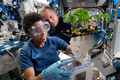
Jessica Watkins and Bob Hines working on XROOTS, an experiment using the Veggie facility of the station testing soilless hydroponic and aeroponic plant growth
-
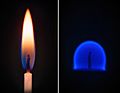
A comparison between the combustion of a candle on Earth (left) and in a free fall environment, such as that found on the ISS (right)
-
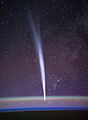
Comet Lovejoy photographed during Expedition 30
-
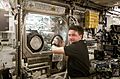
Michael Foale conducts an inspection of the Microgravity Science Glovebox during Expedition 8.
-
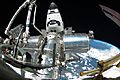
Fisheye view of several labs and the Space Shuttle
-
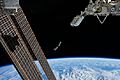
CubeSats are deployed by the NanoRacks CubeSat Deployer.
-
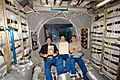
Original Jules Verne manuscripts displayed by crew inside the Jules Verne ATV (Automated Transfer Vehicle)
-
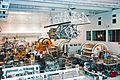
S3-S4 Truss being hoist to the payload transfer container inside the Space Station Processing Facility next to several other ISS modules (2007)
-

Animation of the assembly of the International Space Station
-
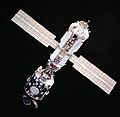
Zarya and Unity, the first two modules of the ISS, pictured in May 2000
-
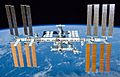
The ISS as seen from Space Shuttle Atlantis during STS-132, pictured in May 2010
-
Blueprint of the ISS (as of 2018)
-
Rendering of the ISS (as of 2023)
-
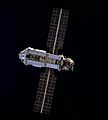
Zarya as seen by Space Shuttle Endeavour during STS-88
-
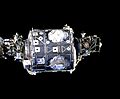
Unity as seen by Space Shuttle Endeavour during STS-88
-
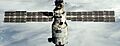
Zvezda as seen by Space Shuttle Atlantis during STS-106
-
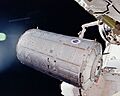
The Destiny module being installed on the ISS
-
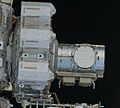
Quest Joint Airlock Module
-
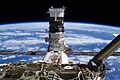
Poisk with its own propulsion module (soon to be jettisoned)
-
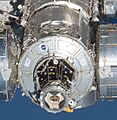
Harmony (center) shown connected to Columbus, Kibo, and Destiny. The dark PMA-2 faces the camera. The nadir and zenith locations are open.
-
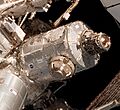
Tranquility in 2011
-
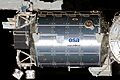
The Columbus module on the ISS
-
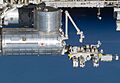
Kibō with its exposed facility on the right
-
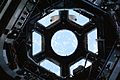
The Cupola's windows with shutters open
-
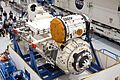
Rassvet module with MLM-outfitting equipment (consisting of experiment airlock, RTOd radiators, and ERA workpost) at KSC
-
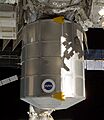
The Leonardo module hours after berthing
-
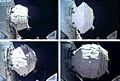
Progression of the expansion of BEAM
-
NanoRacks Bishop airlock module installed on the ISS
-
Nauka and Prichal docked to ISS
-
ISS Truss Components breakdown showing Trusses and all ORUs in situ
-
Construction of the Integrated Truss Structure over New Zealand
-
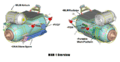
MLM outfittings on Rassvet
-
A wide-angle view of the new module (behind Rassvet) attached to the ROS as seen from the cupola
-
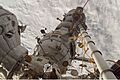
Commander Volkov stands on Pirs with his back to the Soyuz whilst operating the manual
Strela crane (which is holding photographer Oleg Kononenko). -
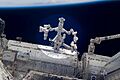
Dextre, like many of the station's experiments and robotic arms, can be operated from Earth, allowing tasks to be performed while the crew sleeps.
-
The Pirs module attached to the ISS
-
ISS-65 Pirs docking compartment separates from the International Space Station.
-
Early rendering of the Axiom Orbital Segment, made prior to assembly plan changes, with now only one module, the Payload Power Thermal Module (PPTM), being planned to dock with the ISS
-
The cancelled Habitation module under construction at Michoud in 1997
-
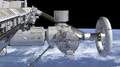
Rendering of the Nautilus-X Centrifuge Demonstrator docked to the ISS (side)
-
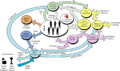
The interactions between the components of the ISS Environmental Control and Life-Support System (ECLSS)
-
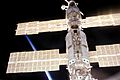
Russian solar arrays, backlit by sunset
-
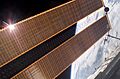
One of the eight truss mounted pairs of USOS solar arrays
-
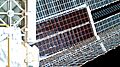
ISS new roll out solar array as seen from a zoom camera on the P6 Truss
-
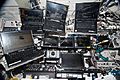
An array of laptops in the US lab
-
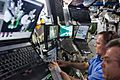
Laptop computers surround the Canadarm2 console.
-
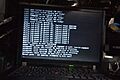
An error message displays a problem with a hard drive on a laptop aboard the ISS.
-
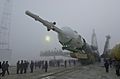
Soyuz TM-31 being prepared to bring the first resident crew to the station in October 2000
-
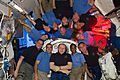
STS-131 and Expedition 23 crew members gather for a group portrait of 13, the maximum the station has hosted, setting the record of four women at the same time in space (2010).
-
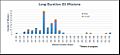
Chart of the number of ISS missions longer than 90 days, until 2020
-
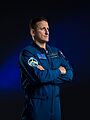
Sergey Kud-Sverchkov, current commander
-
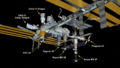
Rendering of the ISS and visiting vehicles as of 1 December 2025[update]. Live link at nasa.gov.
-
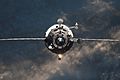
The Progress M-14M resupply vehicle approaching the ISS in 2012. Nearly 100 unpiloted Progress spacecraft have delivered supplies during the lifetime of the station.
-
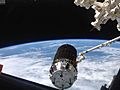
Japan's Kounotori 4 berthing
-
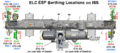
Spare parts are called ORUs; some are externally stored on pallets called ELCs and ESPs.
-
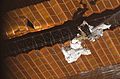
While anchored on the end of the Orbiter Boom Sensor System during STS-120, astronaut Scott Parazynski performs makeshift repairs to a US solar array that was damaged during unfolding
-
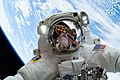
Mike Hopkins during a spacewalk
-
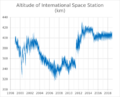
Graph showing the changing altitude of the ISS from November 1998 until November 2018
-
Animation of ISS orbit from 14 September 2018 to 14 November 2018. Earth is not shown.
-
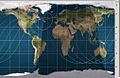
Orbits of the ISS, shown in April 2013
-
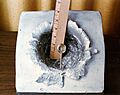
A 7-gram object (shown in center) shot at 7 km/s (23,000 ft/s), the orbital velocity of the ISS, made this 15 cm (5.9 in) crater in a solid block of aluminium.
-
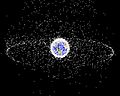
Radar-trackable objects, including debris, with distinct ring of geostationary satellites
-
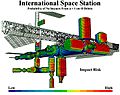
Example of risk management: A NASA model showing areas at high risk from impact for the International Space Station
-
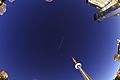
The ISS visible as a skytrack line drawn in the sky nearly overhead shortly after sunset by a long exposure photo
-
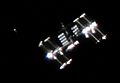
The ISS and HTV photographed from Earth by Ralf Vandebergh
-
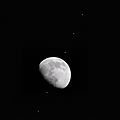
Composite of six photos of the ISS transiting the gibbous Moon
-
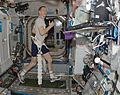
Astronaut Frank De Winne, attached to the TVIS treadmill with bungee cords aboard the ISS
-
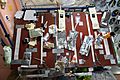
Main dining desk in Unity
-
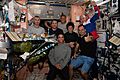
The Expedition 67 crew during a group dinner in Unity
-
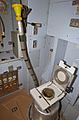
The space toilet in the Zvezda module in the Russian segment
-
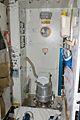
The main toilet in the US Segment inside the Tranquility module
-
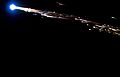
Many ISS resupply spacecraft have already undergone atmospheric re-entry, such as Jules Verne ATV.


.webp)


.jpg)


See also
 In Spanish: Estación Espacial Internacional para niños
